
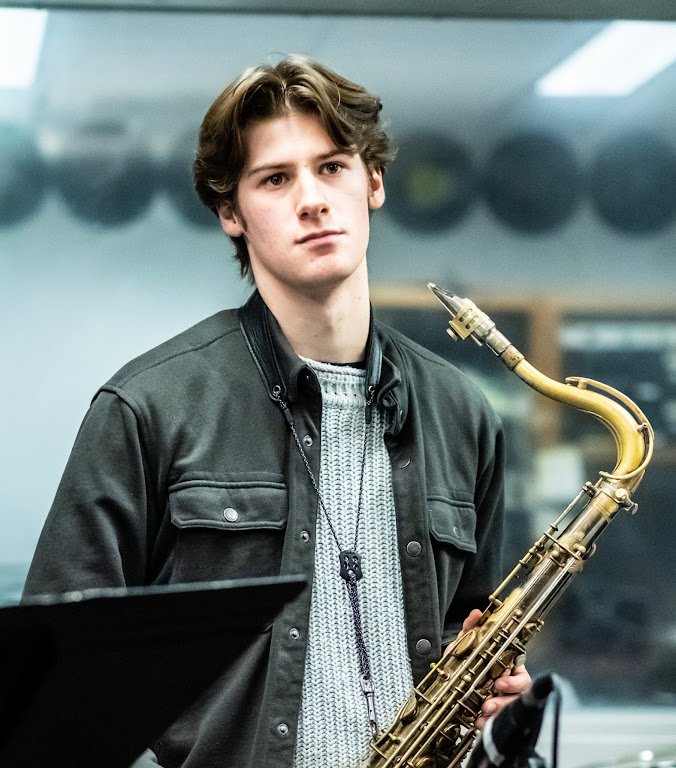
Tenor saxophonist Adam Lamoureux is emerging as a notable voice in New York’s jazz scene, grounded in tradition and focused on developing a sound that feels distinctly his own. In a city defined by constant experimentation, his playing stands out for its sincerity and clarity. WKCR Radio has already called him “one of the brightest young voices on the tenor saxophone,” and his growing presence across major stages suggests the wider community is beginning to take notice.
Lamoureux belongs to a generation of musicians who understand that the future of music depends on the depth of one’s perspective. His playing blends a respect for the lineage of the tenor saxophone with a distinctly contemporary sensibility, shaping a sound that is lyrical, patient, and emotionally grounded. Rather than chasing trends or retreating into nostalgia, he occupies a space where both history and innovation feel equally alive.
Early Roots and a Sound in Formation
Lamoureux grew up in London, Ontario, where the jazz community is small but tight knit, a place where young musicians are given meaningful opportunities to play and learn. He began performing professionally while still in high school, gaining early experience on the bandstand and learning what it means to improvise in real time. These formative years shaped his understanding of the saxophone not just as an instrument, but as a voice capable of nuance, conversation, and storytelling.
He learned quickly that improvisation is as much about honesty as it is about facility. Responding to energy, building melody, and shaping narrative became central to his musicianship long before he formally studied the craft. Those early performances established the foundation he continues to refine today, a foundation built on warmth of tone, clarity of phrasing, and intention behind each musical gesture.
His influences reflect both breadth and depth. Charlie Parker and John Coltrane provided early inspiration, familiar entry points for many saxophone players. But the subtler fingerprints come from the mentors who shaped his musicianship more directly. Artists like Mike Murley, one of Canada’s most respected tenor voices, provided guidance and a model of tone and lyricism. Later, at the Manhattan School of Music, Lamoureux studied with Dayna Stephens, Jaleel Shaw, Donny McCaslin, and Buster Williams. Lamoureux absorbed their lessons as starting points for finding his own tone and phrasing.
“Every great saxophonist I’ve ever listened to had a sound that told you who they were before they played their second note,” he said. “That’s what I’ve been aiming for.”
This pursuit of sonic identity continues to anchor his growth.
Improvisation as Storytelling
What sets Lamoureux apart is not technical fireworks, though he has the facility to execute whatever the moment requires. What distinguishes him is the emotional clarity at the center of his improvisation. His playing is guided by narrative logic and lived experience, grounded in intention and exploration.
There is a roundedness to his sound, a warmth that feels lived in rather than constructed. His improvisations tend to unfold organically, building from melody outward and expanding into modern harmonic territory without losing their internal thread. He favors arcs over bursts, development over density.
This approach resonates with audiences who may not follow every harmonic shift but who can feel when a story is being told with purpose. Musicians respond similarly. Lamoureux listens as deeply as he plays, bringing presence, patience, and a conversational sensibility to every setting.
That commitment to narrative makes his playing feel grounded even in the most exploratory contexts. His solos often move with a sense of inevitability, even when they take unexpected turns, because they arise from emotional rather than purely technical motivations.
Finding His Place on New York’s Stages
If jazz musicians earn their stripes on the bandstand, Lamoureux has been doing so in earnest. He has already performed at Carnegie Hall, Jazz at Lincoln Center, Birdland, The Jazz Gallery, Closeup, Stanford University, and Kuumbwa Jazz Center. These opportunities have placed him onstage with peers who are shaping the next era of jazz, as well as established, highly regarded musicians such as GRAMMY-winning bassist John Benitez.
Each of these environments and musical situations demand something different and Lamoureux’s versatility across these spaces reflects his adaptability, and his ability to integrate into varied musical contexts without compromising the integrity of his voice.
Within New York, he is becoming a familiar presence: someone who plays with conviction and brings a modern tenor concept that fits comfortably alongside the city’s established voices while still pushing outward. His sound is distinct enough to be recognized, yet fluid enough to serve the needs of whatever ensemble he joins.
This balance between individuality and service is a hallmark of serious musicianship, and Lamoureux demonstrates it consistently in his performances.
A Bandleader With a Clear Vision
While many young musicians spend years exclusively as sidemen, Lamoureux has been equally committed to developing his own music. His quartet, which performs his original compositions, embodies the qualities that define his playing: emotional clarity, narrative focus, and an approach that lives in the space between tradition and modernism.
His pieces often evolve through shifting textures, lyrical motifs, and a sense of pacing that mirrors the way he improvises. They carry echoes of the lineage he has studied yet feel shaped by the city he now inhabits. New York demands evolution, and Lamoureux’s writing reflects a musician willing to grow without abandoning the values that first drew him to the music.
These compositions will form the foundation of his upcoming debut album, a project designed to introduce his compositional identity alongside his instrumental one. The album represents the next step in his artistic development, an opportunity to present a cohesive musical vision shaped by years of performance, study, and personal exploration.
A Voice Emerging in Real Time
Lamoureux belongs to a generation of saxophonists who value versatility, collaboration, and authenticity. He is not interested in recreating a past era of jazz, nor in rejecting the tradition that shaped him. Instead, he exists in the productive tension between the two, finding ways for the tenor saxophone to be both rooted yet forward-looking, carrying the lineage while shaping something distinctly current.
The recognition he has received so far reflects the promise of his work. But beyond accolades, what stands out is the steadiness of his evolution. His presence in New York has been defined by consistent, thoughtful growth. Each year his voice expands, matures, and strengthens.
Looking Forward
As Lamoureux prepares to release his debut album and continues to work with leading artists across New York and the country, his trajectory feels both deliberate and wide open. Although still early in his artistic life, his voice is unmistakable, and his arrival on the New York scene has been the start of something built slowly and intentionally, with the potential for long-term significance.